
The early experiences that taught Alain Lagger how people really operate under pressure.
 When Alain Lagger walks into a prison classroom today, the men inside usually don’t know that his connection to the justice system began long before he ever led a workshop. At fourteen, growing up outside Amsterdam, Lagger was arrested for stealing a moped and spent the night in a police cell. The experience wasn’t dramatic, but it was decisive. He left determined not to return.
A few years later, he saw a documentary about a detective who worked with at-risk youth. By coincidence, he ran into that same detective soon after. The man brought him onto his youth surveillance team and eventually placed him behind the front desk of the local police station. Lagger was sixteen.
It was an unusual vantage point for a teenager. People walked in on their worst days, not their best. Domestic violence survivors. Burglary victims. People who were furious, ashamed, shaken, or resigned. Instead of retreating, Lagger observed. He noticed that what people presented rarely matched what they were actually feeling. Pressure distorted behaviour, and emotion dictated decisions far more than logic did.
At seventeen, the police commissioner approved an exception allowing him to enter police academy early. A year later, he was patrolling the city he grew up in, now seeing the same patterns he’d first noticed at the front desk. Crises varied, but their origins didn’t: fear, isolation, frustration, and lack of support created predictable outcomes in people’s choices.
 One incident sharpened this understanding. Responding to a call involving a man with a knife, Lagger found himself seconds away from firing his weapon. The moment de-escalated before a shot was fired, but the conversation he had with the man the next day clarified something he had sensed for years: the distance between “officer” and “offender” was largely circumstantial. Their lives had simply diverged at different points.
The following day, Lagger resigned. He didn’t believe traditional enforcement was the most effective way to influence behaviour. The people he met weren’t fundamentally different from anyone else; they were operating under internal pressures they didn’t know how to navigate.
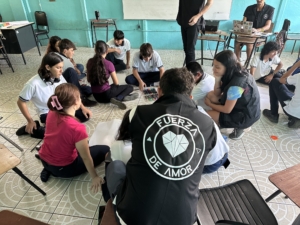
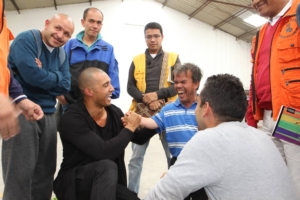
Today, Lagger works inside prisons across Latin America and beyond, leading behavioural workshops grounded in a blunt question: What actually drives human decision-making under stress? Many participants have spent years being defined by their charges rather than their internal patterns. Lagger’s direct approach breaks through that. He explains how thoughts escalate, how reactions form, and how pressure narrows perception. It’s not therapy. It’s mechanics.
The simplicity of that framework is often what shifts the room. For many inmates, no one has ever explained behaviour without moralising it. Once they understand the pattern, they can interrupt it.
Lagger’s work has expanded beyond conversation. In Colombia, he is helping develop a regenerative farm inside a prison. Instead of punitive labour, inmates learn land stewardship, soil restoration, and agricultural skills they can use after release. It’s a rehabilitation model based on responsibility and capability, not compliance.
 Parallel to this, he is creating a free year-long workbook designed for anyone who wants to understand their own behavioural patterns without needing formal intervention. It breaks down internal processes the same way he does in his prison programs: plainly, without jargon, and with an emphasis on cause and effect.
Across communities, prisons, and leadership groups, Lagger’s approach remains consistent. He treats behaviour as something understandable, not mysterious; modifiable, not fixed. He isn’t asking people to become different. He’s asking them to understand how they operate when pressure mounts so they have a shot at choosing differently.
His trajectory from teenage arrest to prison reform work isn’t a reinvention. It’s continuity. He has spent years watching people at the breaking points of their own lives. Now he works at the point where change is still possible.
To explore Lagger’s current projects or access his free resources, visit www.alainlagger.com or follow him at: @alainlagger.

